
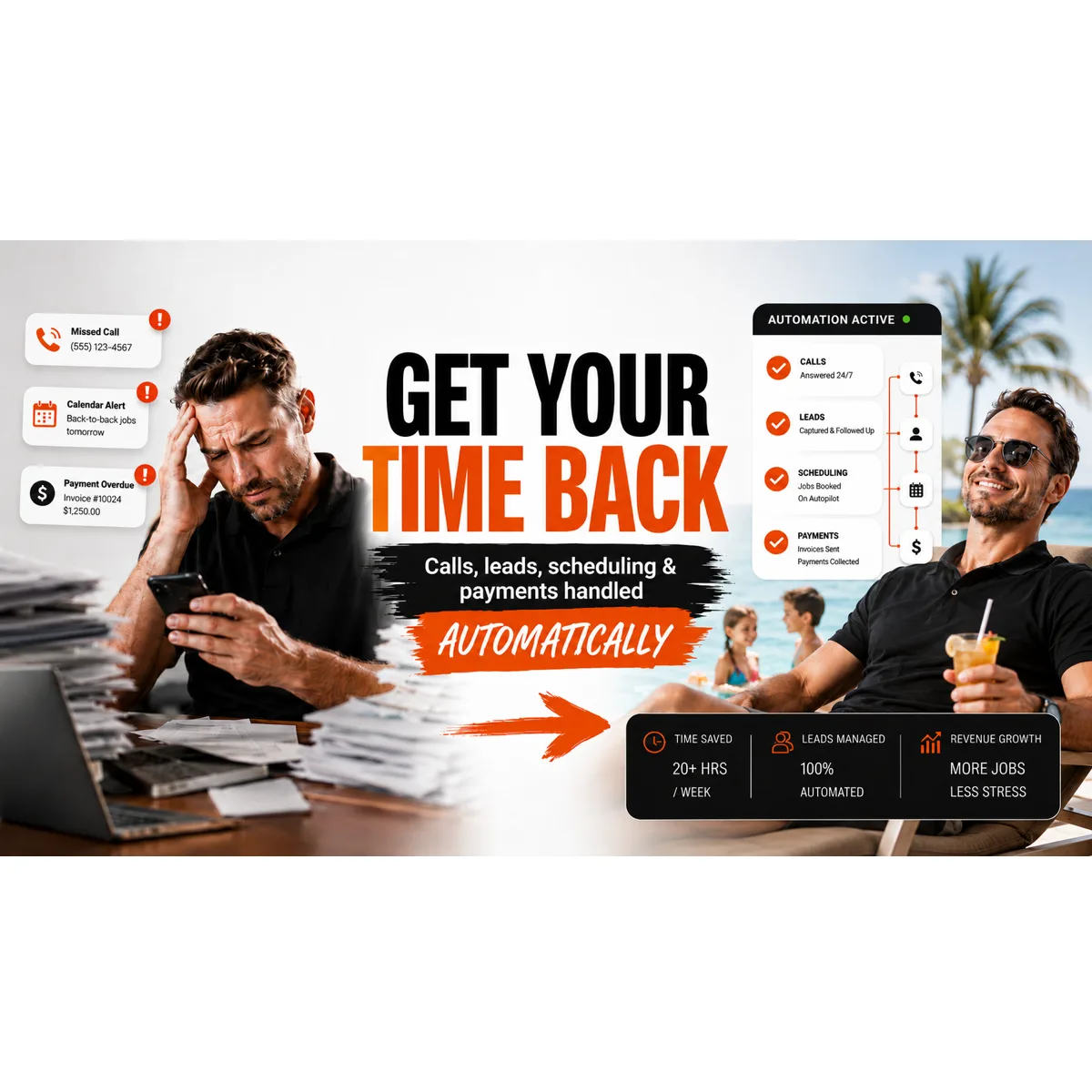
You did not start your business to spend every day answering calls, sending estimates, chasing invoices, and reminding customers to leave a review. You started it to build something. At some point, the business started running you instead of the other way around. That is the problem AI workflows solve.
This is not about replacing your team or turning your business into a robot. It is about building a system that handles the repetitive, time sensitive tasks that fall through the cracks every day, so you can focus on the work that actually requires you.
What AI Workflows Actually Do for a Service Business
An AI workflow is a connected sequence of automated actions triggered by a specific event in your business. A new lead fills out a form. A job gets marked complete. A payment comes in. An invoice goes unpaid for 48 hours. Each of those events can trigger a chain of automated responses, messages, and tasks without anyone on your team lifting a finger.
For a service business, this typically covers four core areas: lead response, scheduling and confirmation, payment collection, and review generation. These are the exact areas where most service business owners spend the most time and where the most revenue slips through the cracks when things get busy.
The key word is connected. A basic autoresponder is not a workflow. A real AI workflow knows the context. It knows whether a lead has already been contacted. It knows whether a job is complete or still in progress. It adjusts what it sends and when based on where things actually stand. That is what separates automation that works from automation that creates problems.
The Four Parts of Your Business You Can Automate Right Now
Lead response. When someone contacts your business, the first business to respond wins. Most service business owners respond hours later, sometimes the next day. An AI system responds in under 60 seconds, gathers basic information, and either schedules a callback or routes the inquiry to the right person automatically. You stay in the conversation from the start without being the one who starts it.
Appointment booking and confirmation. Back and forth scheduling is one of the biggest time drains for service business owners. An automated booking system lets customers pick a time that works, confirms it immediately, and sends reminders the day before and the morning of. Cancellations trigger an automatic reschedule request. Your calendar fills without a single phone call.
Payment collection and invoicing. Sending an invoice after every job, waiting for payment, sending a reminder, then following up again takes hours every week across a full schedule. Automated invoicing sends the invoice when the job is marked complete. A follow up goes out automatically if payment has not arrived. You get paid faster and you never have to chase anyone.
Review generation. Google reviews are one of the most powerful signals for local search rankings. Most service businesses get reviews only when a customer volunteers one. An automated review request sent 24 hours after a completed job via text generates far more reviews without any extra effort from your team. Service businesses in London and across England that run automated review sequences consistently outrank competitors who wait for organic reviews.
What Your Week Looks Like When the System Handles It
Most service business owners lose 15 to 20 hours a week on administrative tasks that could be automated. That is two and a half full workdays every week. When those tasks run automatically, those hours come back. Some owners use them to take on more jobs. Others use them to step back from the day to day and work on the business instead of in it.
The transition takes a few weeks. The first month is about building and testing the system so it matches how your business actually operates. Within 30 days, the automation is handling incoming leads, booking appointments, sending invoices, and requesting reviews without anyone managing it. The phone still rings. You still run the jobs. The backend runs itself.
Where Service Business Owners Are Starting
The most common starting point is lead response. It has the highest immediate impact and the clearest return on investment. A service business in Richmond that responds to leads within 60 seconds will close more jobs than a competitor who gets back to people the next morning. That single improvement alone pays for the system many times over.
From there, most businesses add scheduling automation, then payment collection, then review generation. By the time all four are running, the owner has effectively built a second operations layer that handles itself. Service businesses in Sutton, Greenwich, Bristol, and Birmingham are already running this kind of system. The owners who implement it first in their market have a real advantage over those who wait.
If you want to understand what your specific business could automate, read our breakdown of AI voice agents for home service businesses. And if you want to know how to get more calls from Google at the same time, our guide to getting more Google reviews automatically is a good next read.